The tomb of the First Emperor of Qin is located at the junction of the diluvial fan group in front of Lishan and the loess plateau, with a high southeast and low northwest topography. Although the short-duration rivers formed by more than ten valleys of various sizes at the northern foot of Mount Li served as important channels for the drainage of the tomb area during the rainy season, allowing surface water from the tomb area to be injected into the Wei River along ancient channels. A complete drainage system was also designed during the construction of the tomb to ensure the absolute safety of the imperial tomb.
After archaeological excavations, we found a curved ruler-shaped trench about 15 meters wide and 8 meters deep on the southwest side of the main mausoleum seal, in the inner city wall, from which surface water from the high ground south of the mausoleum mound was drained out of the city. In contrast, water on the northern side of the earthen mound was drained out of the city by an underground drainage system that drained surface precipitation. In addition, three parallel rows of drainage channels were found beneath the inner city in the west of the mausoleum, directly draining rainwater from the inner city to the outer city. A number of drainage channels were also found within the building sites found in the inner and outer city of the tomb. The arrangement of these drainage channels was reasonably matched to the volume of water in the area where they were located, with single rows connected, three rows side by side, or even six rows side by side, forming a drainage network that effectively solved the problem of draining large volumes of water from the surface of the mausoleum.
Three Parallel Rows of Drainage Channels
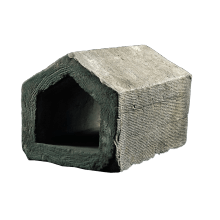
So, what does this underground drainage channel look like? There are two types of drainage channels, stone and ceramic, and the stone channel is made of two plates of stone cut into the middle with a single, double or triple hole, with a diameter of 27 cm. The ceramic watercourse is round, decorated with a rope pattern on the outside and a pockmarked pattern on the inside. The round channels are not cylindrical, as one might expect, but large at one end and small at the other, so that they can be connected to each other and lengthened for use. In addition to the circular drainage channels, three parallel rows of pentagonal waterways were found under the inner city to the west of the Qin Shi Huangdi tomb. A drainage pipe with a funnel and elbow was also found at the site of the food official between the inner and outer city to the west of the mausoleum, which was connected to the underground drainage channel, allowing indoor sewage to be easily discharged through the ground. The small-scale drainage of buildings such as the Bedchamber, the Rest Hall, and the garden and temple was carried out by means of soakaways, which were dug at appropriate locations around the buildings and connected to various underground watercourses, leading to the outdoors directly.
Pentagonal Waterway
Soakaway
The above archaeological findings of different drainage facilities in the mausoleum of Qin Shi Huang, together with the ancient river channels on the east and west sides of the Qin Shi Huang tomb constitute a complete drainage network system. It is a well-thought-out design and a reasonable layout of the network, which is relatively rare in the history of ancient Chinese imperial mausoleum architecture. In the Western Han Dynasty, a brick drainage ditch was found around the earthen mound of the tomb of Emperor Jingdi Yang, indicating that drainage facilities were installed in the imperial tombs. Unfortunately, this drainage network was so badly damaged that today we can only get a general idea of its condition through scattered remains.